Vibe code Full Stack Apps using AI and Open Source
When you create software with Lovable or Bolt44, you compromise on things such as security and privacy in return for comfort. Most citizen probably don't care about that, but for a serious company or an enterprise, this makes these platforms almost completely useless.
Magic Cloud is different. First of all it's open source. In addition you can easily deploy it on your own server infrastructure in a couple of minutes using its Docker images. However, and more importantly, on the backend side of things, it is simply superior to Lovable and others - Because of our Hyperlambda Generator.
Contrary to Lovable and others you see, we're not a "ChatGPT wrapper". Instead we did it right from the get go, and first created a unique programming language, serving as a DSL - For then to create our own LLM that generates code for it. Basically, we have all the innovation that Lovable does not have - And the innovation we do have, happens to be the exact type of innovation that serious companies needs when generating software using AI.
Below are some of the things that makes our DSL completely unique.
Hyperlambda and Security
The name of our DSL is Hyperlambda, and it can do some pretty amazing things none of our competitors can - Because it was built to be an AI language from day one. So where Python and JS was created for human beings, Hyperlambda was literally created as a "machine language", not intended for human beings to manually edited - But rather to have the machine "generate" the code. Because of this, we built in security mechanisms into the language that is completely unique for Hyperlambda, and basically a requirement for you to generate secure code.
Every single time somebody mentions the disadvantages of "vibe coding", the word security comes into the sentence. Don't believe me? Then I challenge you to find one post talking negatively about vibe coding without mentioning the word "security". I suspect you can't.
With Hyperlambda, executing insecure code is almost impossible
First of all the language runs in a sandbox, containing a virtual file system. This prevents the language from applying changes to anything but its own files. This is similar to the security found in much more complex systems, such as Unix and Linux.
Secondly, the language contains security mechanisms allowing you to use its integrated RBAC features to secure your code, preventing both the AI agent and unauthorised users from executing code they should not be allowed to execute. Below are some of its security features to put things into perspective.
- Passwords saved using individual per record based salts, and slow hashed using bcrypt.
- Virtual sandbox prohibiting the system from reading files outside of its own environment.
- RBAC or role-based access-control to grant access to users according to their roles.
- Hyperlambda execution model, allowing for "whitelisting" individual functions, preventing malicious code from being executed.
- Etc, etc, etc ...
Hyperlambda was built from the start to be secure, and easy to understand for machines. Python and JS was built to be powerful, and easy to read and write for humans. This makes Hyperlambda 10x "better" than both Python, JavaScript, C#, GoLang and Java - At least within an LLM context.
To understand the security features in Hyperlambda you can read more and even test it at our natural language API page.
Tokens
When generating code using AI, token count becomes crucial - And no, it's got nothing to do with "price", even though the price obviously becomes much smaller when reducing them. The reasons why tokens becomes so important, is because as you reduce the tokens produced by the LLM, you reduce "cognitive complexity". This allows the LLM to become much more comfortable on the code it produces, results in fewer bugs, and allows it to create more complex apps. Basically, the less energy it needs to spend on considering the syntax of a loop, the more energy it's got to think about your problem.
Hence, the simpler your language is, the more complex apps the LLM can produce without messing anything up. C# is 10 times as complex as Hyperlambda, and Python is 5 times more complex. Below is a simple CRUD read endpoint to illustrate the point ...
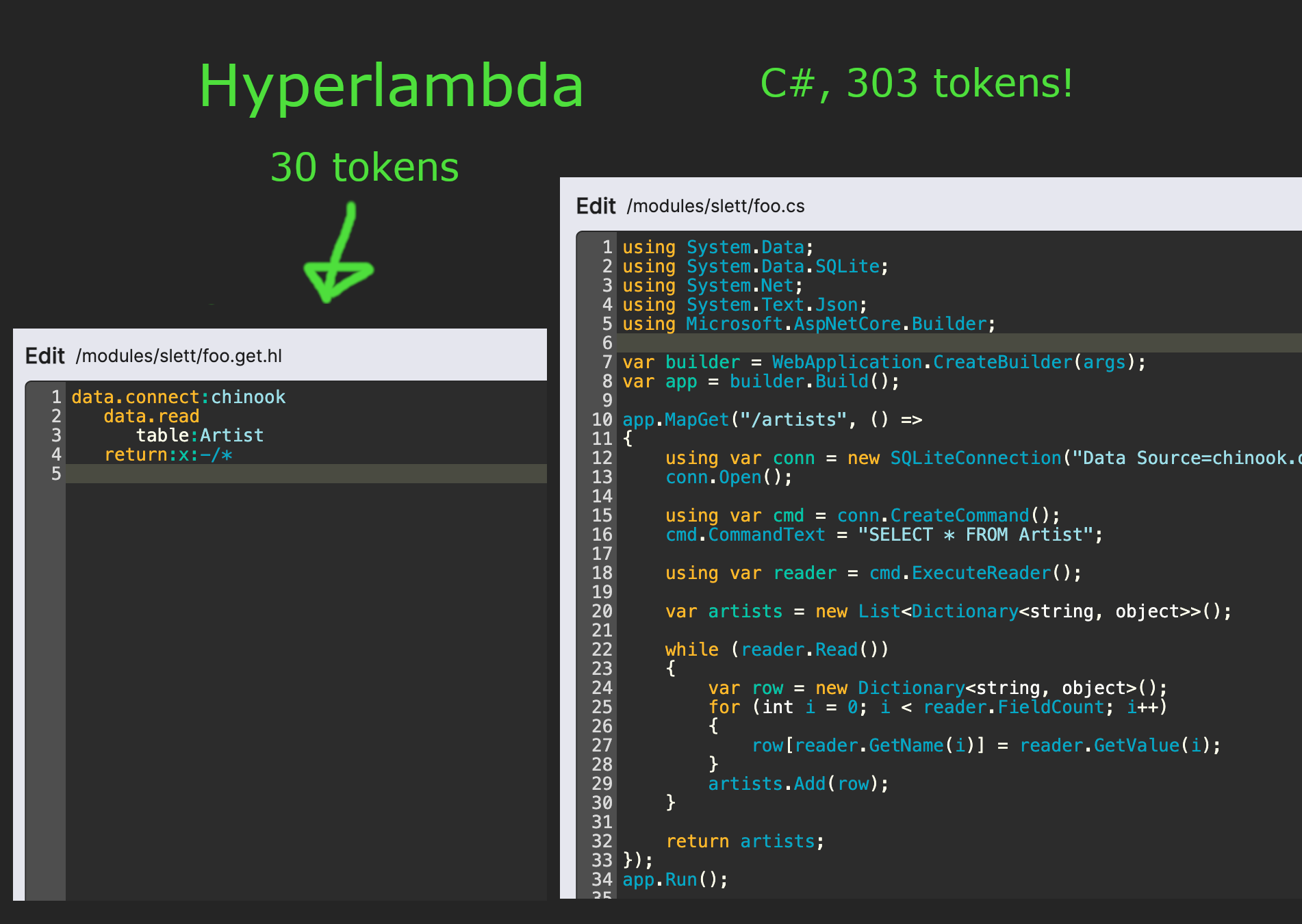
On average Hyperlambda consumes 10% of tokens C# needs, and about 20% of tokens Python needs. Simply extrapolating using basic math, this implies that our AI agents can build, at least in theory, roughly 5 to 10 times as "complex" apps before it's exhausted its "cognitive capacity".
In addition to the above obvious benefits, Hyperlambda has a lot of additional unique traits that makes it extremely well suited for "AI programming" - Such as for instance ...
- It's a homoiconic programming language, or an AST (Astract Syntax Tree).
- It's a declarative programming language, similar to SQL in such a regard.
- There is no OOP, only functions and files
- Etc, etc, etc ...
Execution speed
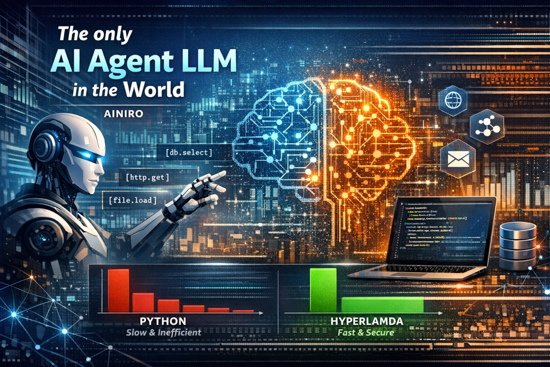
Every time somebody talks about DSLs, I cringe. Either they're too narrowly focused, and don't allow me to create the functionality I need - Or they're slow and dirty, storing XML files in my database, or dependent upon JSON files to "configure and wire up things", and feels like swimming in sirup if you add too much logic. Well, I am happy to announce that Hyperlambda contains no XML "configuration files", and is actually 20x as fast as Python on average.
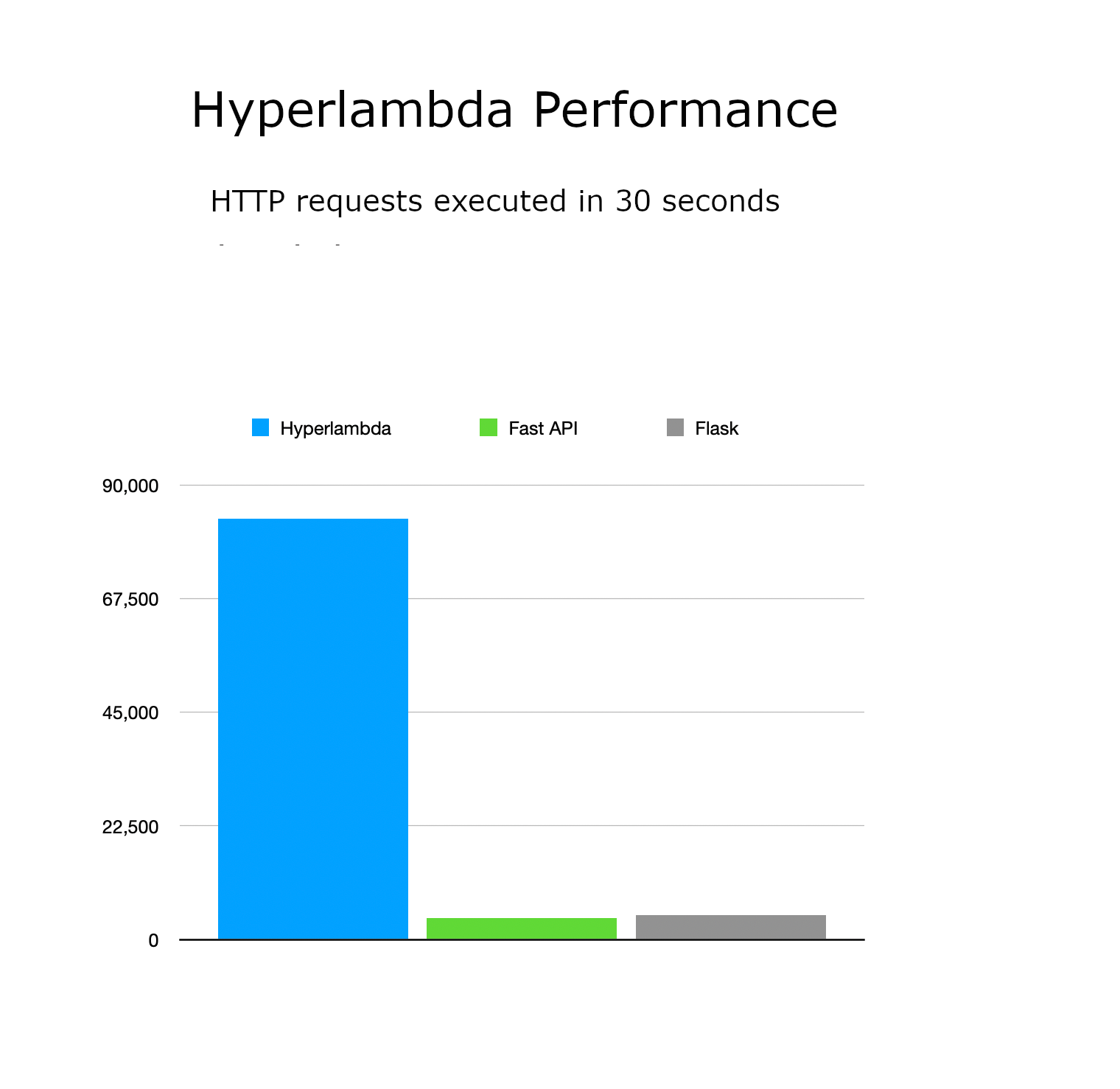
Extrapolating the above figures makes Magic and Hyperlambda some roughly 100 times faster than LangChain. Hence ...
- Hyperlambda is 100x more secure than Python
- Hyperlambda is 90% less expensive than Python
- Hyperlambda is 20x faster than Python
- Hyperlambda scales 20x better than Python
Psst, 70 to 90 percent of AI agents today are built in Python - Implying if you create a "hello world" app in Hyperlambda, you're already outperforming your competitor's Python version ...
Convenience
However, its absolutely most important point is convenience. When I tell Magic Cloud to create me a full stack app, it creates everything for me, and even automatically deploys everything on my server!
- It creates my database
- It creates my API
- It creates my frontend
And when it is done with the above my system is in production! No "deployment pipelines", no "compilation", just save and launch!
This is because the runtime environment and execution environment is one in Magic. There is no separate "development server" and "deployment server". This makes your job of providing the LLM with feedback much easier. From you have an idea, to the LLM is finished implementing it, and you can test it, can be done in some few seconds.
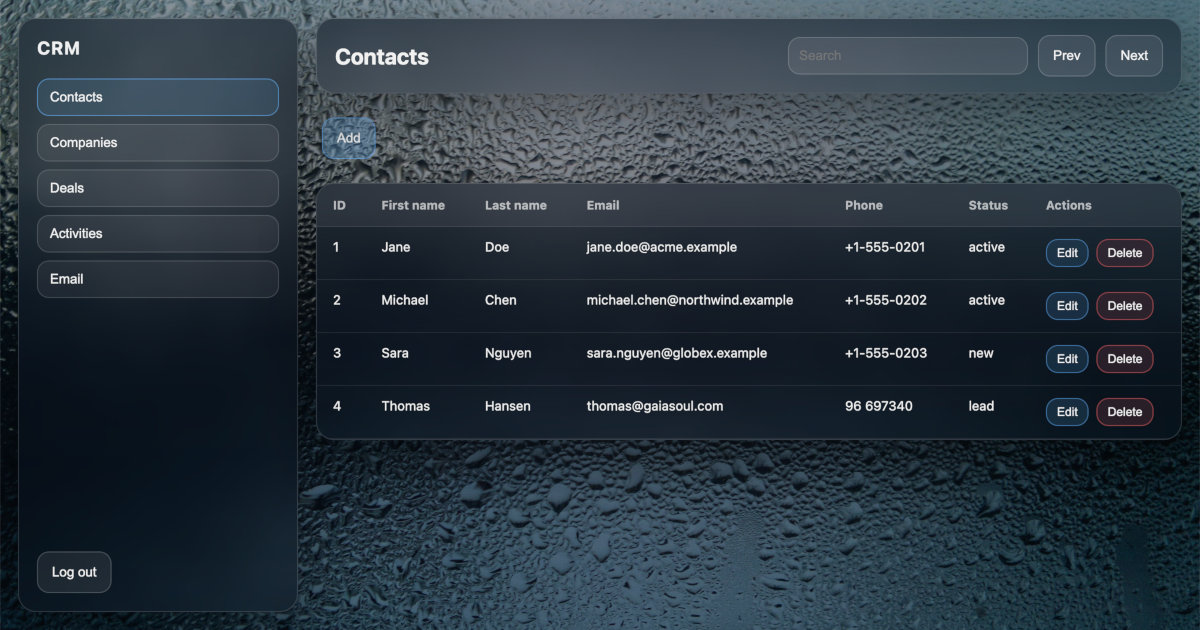
This allows you to install Magic's Docker images, tell Magic to "create a CRM system", and have a fully functioning CRM system in less than 10 minutes - IN PRODUCTION!
Deployment
Contrary to Lovable, where you read their terms of services statement, their privacy policy, and basically pray before you input data - Magic Cloud can be installed 100% on your infrastructure. This allows you to install it on a private server, only accessible from within your LAN. It also comes with full source code, a plugin architecture that dwarfs everything out there, and a dynamicness allowing you to modify it to become exactly what you want it to be.
This opens up an entirely new vertical, which are large companies and enterprise companies, that now "all of a sudden" have a secure method to use AI to vibe code entire full stack applications. Example use cases includes for instance ...
- CRM systems
- Project tracking systems
- Task management systems
- Back office administration apps
- Etc, etc, etc ...
Building a CRM system with Magic
Today I recorded a video of myself building a CRM system. The system has roughly 8 tables, and allows me to save companies, contacts, leads, notes, and activities. In addition, I can send emails to contacts, and the system is secured with RBAC using JWT tokens. It's of course nothing like Salesforce or HubSpot, but actually that's a feature. If you don't understand why, then please count all the buttons or controls in your own CRM system you have literally never clicked.
Below you can see me demonstrate the system.
CRM systems are of course the obvious use case. First of all, because they're corner stone systems in any company - And more importantly, every company have unique business processes, and their CRM systems needs to accommodate for these - Something an "off the shelf" system simply never can, because it was created to "please everybody".
So even though the paradox is that Salesforce and HubSpot have "a bajillion" features, they can never be as flexible or configurable as a completely custom solution. If you need a great use case for "vibe coding", my suggestion is to start out with creating a custom CRM system. And yes, seriously, outperforming Salesforce having 75,000 employees in this space, should be fairly easy ...
... simply because ...
Only YOU know your existing business workflows well enough to understand how to create it ... 😉
Psst, the backend code can be found here ...