The $171,000 a Year You're Wasting Building Backends by Hand
Everybody is talking about how much faster AI agents make us. Almost nobody is talking about how much they cost while doing it.
I spent an afternoon this week measuring something very specific: the price of building a small backend two different ways. Once the way a modern coding agent does it from scratch, and once the way Magic Cloud does it. Same result both times; a database, a working API, and role-based security. The difference in what it cost to get there was almost embarrassing.
So let me show you the numbers, because I think most CTOs are quietly bleeding money and calling it "innovation".
The exact thing I built
Nothing fancy, and that's the point. I asked for a task manager backend:
- A database with a
clientstable and ataskstable. - A foreign key so every task belongs to a client.
- A full CRUD API. Create, read, update, delete, for both tables. Eight endpoints.
- All of it locked down to a single
guestrole, so it can't touch anything it shouldn't.
This is the bread and butter of internal software. CRMs, task trackers, back-office tools, integration endpoints. If your team builds business software, they build some version of this every single week.
In Magic, it was a sentence. The Hyperlambda Generator wrote each endpoint, saved it, and it was live and secured. Minutes, not hours.
Now the part that hurts
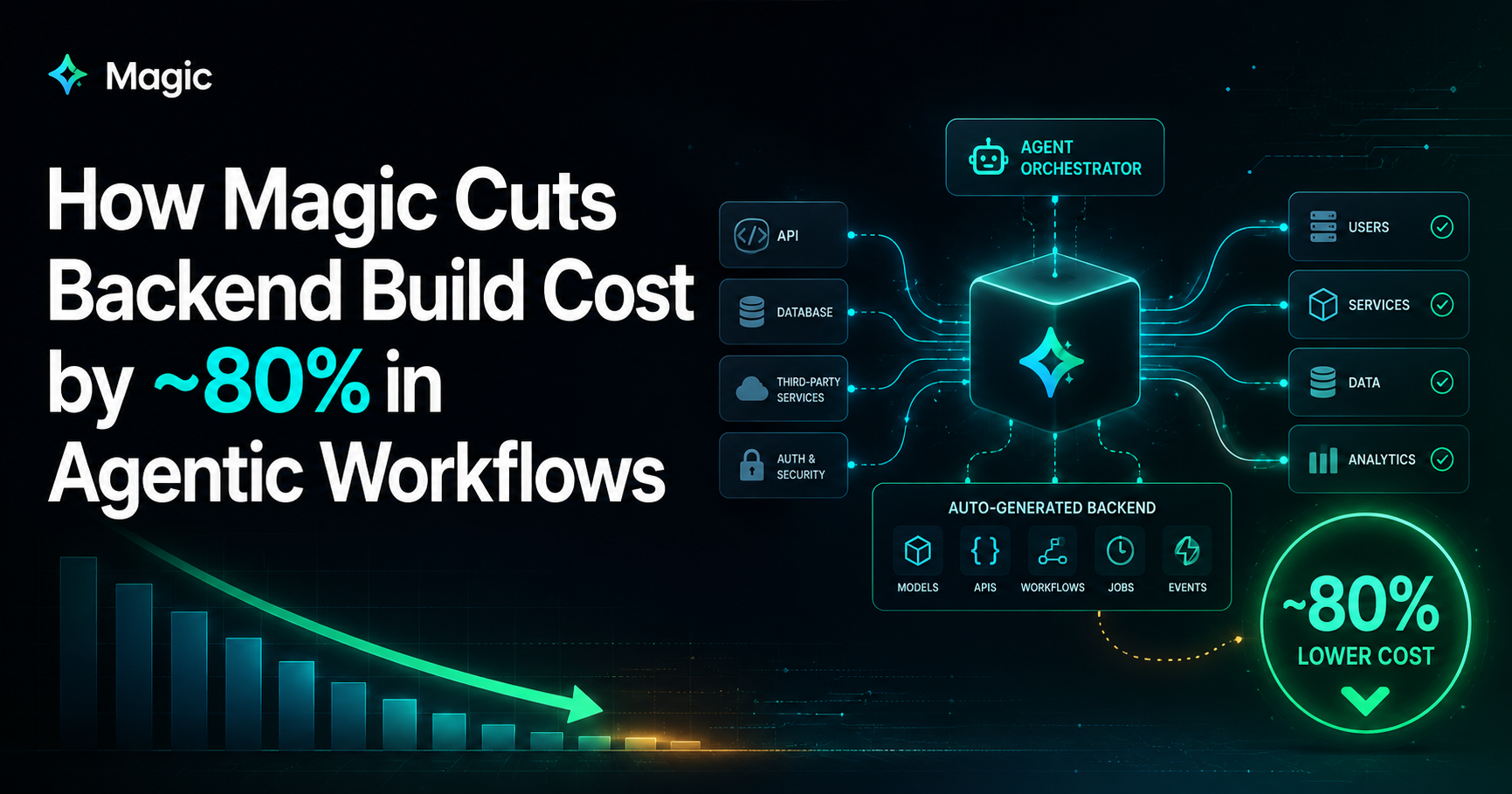
Doing the same build from scratch, with a coding agent writing a server, wiring routes, rolling its own JWT auth, installing dependencies, debugging, and deploying, chewed through roughly 140,000 tokens.
The Magic version cost about 25,000.
That's an ~80% reduction on one small backend. And it isn't because the from-scratch agent is dumb. It's because two specific things are genuinely expensive to build by hand, and Magic makes both of them disappear into the prompt:
- Authentication and RBAC. From scratch that means a users table, password hashing, token issuing, verification, and role middleware, all written and debugged. In Magic, "only the guest role can call this" is a clause in a sentence, because RBAC is the default execution model, not an afterthought.
- Hosting. The from-scratch endpoints are just code until somebody deploys them. Magic's came out live on a real URL. There is no "step two".
The actual application logic, the CRUD itself, is the cheap part. The expensive part is everything around it, and that's exactly the part Magic deletes.
Turning tokens into a real invoice
One build saving a few thousand tokens is a cute demo. A team doing this all day is a budget line.
The newest premium models are not cheap. Metered, you're looking at roughly $10 per million input tokens and $50 per million output. Now put that against a real team; say 25 developers, using AI heavily and agentically as a core part of how they work.
Run the math on the slice of their work that Magic actually addresses, backend and integration tasks, and it lands around:
- ~$14,300 saved every month
- ~$171,000 saved every year
- Roughly a 36% cut in total token spend, and about 80% on the backend slice itself
That is not a rounding error. That is a salary. It's the difference between hiring another engineer and not.
I liked the numbers so much I built an interactive calculator where you can plug in your own headcount, token usage, and rates and watch it move. Drag the sliders. It's uncomfortable in the best way.
"But the tokens are the small part"
Correct. And that's the argument for Magic, not against it.
The token bill is just the part I can measure cleanly. The bigger cost is time. A hosted, auth-secured API like the one above is a solid half-day of real engineering when you build it by hand; schema, server, endpoints, JWT, role checks, a deploy, and the inevitable debugging in between. With Magic it was minutes of describing what I wanted.
Hours to minutes, repeated across every backend task your team ships this week. For an agentic team, the reclaimed engineering time dwarfs the token savings. I'm leading with the tokens only because they're the number nobody can argue with.
Why we can do this and the toys can't
This is where I get to be a little smug, so bear with me.
- Magic is open source and self-hostable. No Supabase, no Hasura, no per-seat lock-in tax quietly compounding on top of your token bill. Clone it, Docker it, run it forever.
- Hyperlambda is a constrained runtime, not free-form generated source. It's dramatically more token-efficient than having a model write and re-write C#, Python, or a pile of LangChain glue.
- Security isn't "prompt engineering". The runtime is the boundary. Generated code can only touch explicitly whitelisted capabilities, so a hallucination can't quietly hand
guestthe keys to your PII.
Cheaper, faster, and safer isn't supposed to be allowed to be the same sentence. In this case it is.
The honest version
I'm not going to pretend every hour of every developer's day gets 80% cheaper. It doesn't. General coding, writing, thinking, and analysis cost the same whether or not Magic is in the room. The savings live in the backend and integration slice, and the numbers above are a model built on sensible assumptions, not a bill I photographed.
But that slice is big, it's constant, and right now most teams are paying full price for it, in tokens and in hours, to rebuild authentication and hosting they could have described in a sentence.
Point Magic at the problem, describe the database, the API, and the roles you need, and let the Hyperlambda Generator do the expensive part for you. Then go spend the $171,000 on something that actually needs a human.
You can get started here, or talk to us if you'd rather we show you on your own stack.