No-Code, End to End: How Claude Created an AI Chatbot with Lead Capture, API, Database, and Email
Most people still think AI is about generating snippets of code, maybe answering a question, or helping you write a regex you don't understand. That's already obsolete.
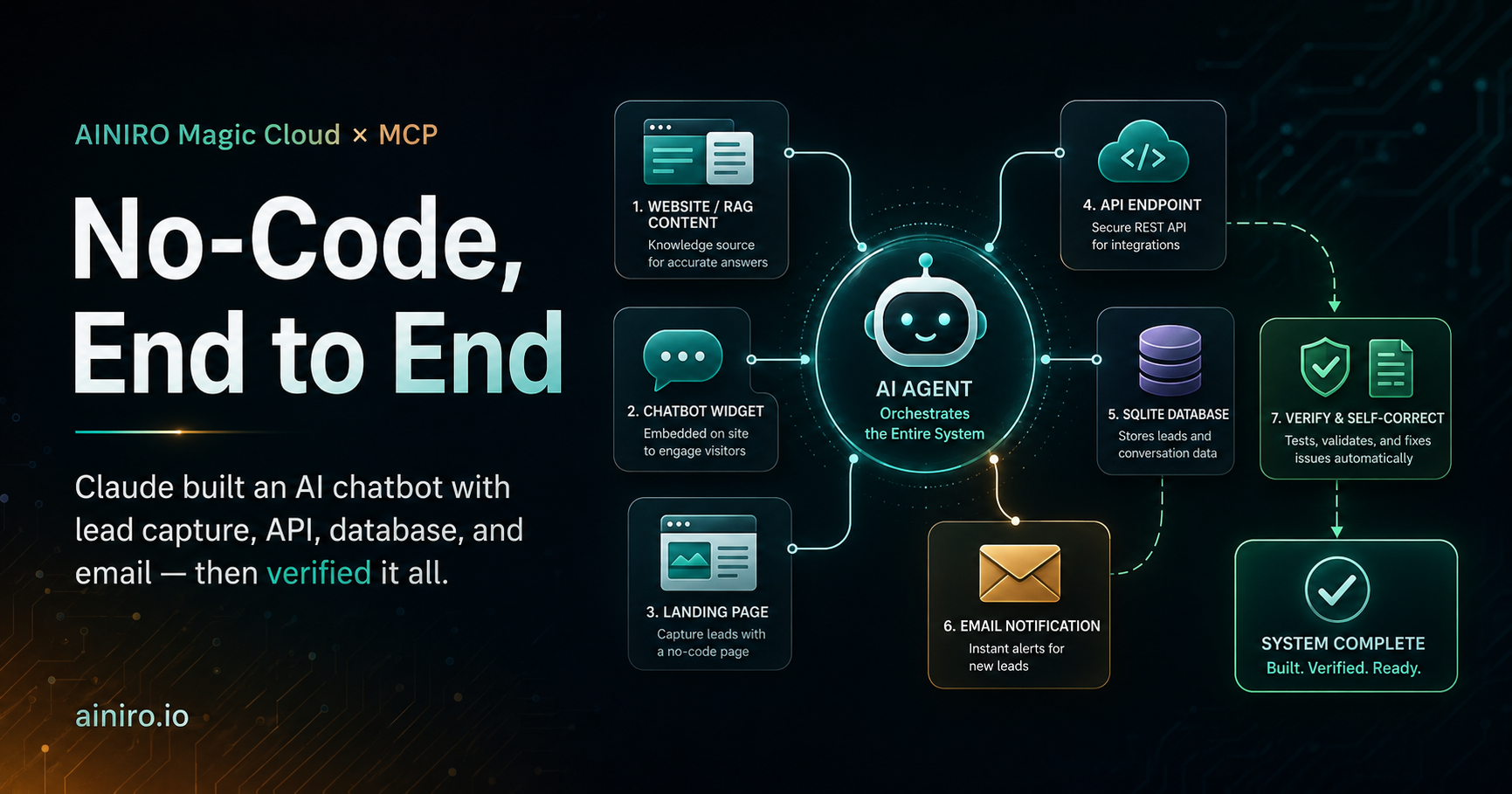
A few days ago we connected Claude to AINIRO's Magic Cloud through MCP and gave it a single prompt. A few minutes later it had created a complete AI chatbot trained on website content, a lead capture widget, a backend API, a database, email notifications, and a landing page. Not only that, but it also verified every important part before reporting the job as done.
No code was written by hand.
This article explains what happened, why it matters, and why the interesting part is not simply that the AI built the solution - But that it corrected itself when one part failed.
The prompt
The prompt was the following in spirit.
Create an AI chatbot trained on ainiro.io (5 pages), plus a widget with a backend API that captures visitor names and emails, saves them to a database, and sends an email notification for every new lead. Use "test6" for the database and module, and serve a landing page embedding the chatbot at /test6.
Notice what's missing here. We didn't tell Claude what tables to create, what files to save, how the endpoint should be implemented, how the widget should work internally, or how the page should be styled. We described the outcome, not the implementation.
That's an important distinction. When software is created through natural language, the best prompts often describe the business goal and the constraints, and then leave the machine to figure out the wiring.
Creating the chatbot itself
Claude started by creating a machine learning type called test6. It gave it a sales and support oriented system instruction, then crawled ainiro.io across 5 pages. This produced 15 RAG training snippets, after which it triggered vectorisation as a background process.
This is the first important part of the story.
The chatbot was not some generic LLM wrapper with a logo slapped on it. It was actually trained on live website content. This implies it had a concrete knowledge foundation taken from our own site, allowing it to answer questions based upon the material it had just ingested.
This is also why RAG matters. Without RAG, the chatbot is just a language model guessing. With RAG, it can use your own content as context and answer as if your website had become conversational.
If all Claude had done was stop here, it would already have created something useful. But that was only the beginning.
Creating the database and backend foundation
The next step was to create a SQLite database called test6. Inside this database, Claude created a leads table with the following fields.
idnameemailcreated
At the same time it created a module also called test6, intended to host the backend API.
This might sound boring, but this is exactly where most AI chatbot demos stop being interesting. A chatbot that can answer questions is one thing. A chatbot that is capable of becoming part of your business process is something else entirely.
If your chatbot cannot save data, trigger workflows, notify sales, or integrate with your backend - Then it is mostly just an expensive toy.
Generating the lead capture API
Once the database and module existed, Claude used Magic's Hyperlambda Generator to create a backend endpoint. The endpoint became the following.
POST /magic/modules/test6/save-lead
This endpoint was public and designed to do exactly what the prompt asked for.
- Validate the visitor's name
- Validate the visitor's email
- Insert the lead into the
test6database - Send an email notification containing the lead details
The remarkable part here is not the endpoint itself. Creating an endpoint like this is not difficult for a decent developer. The remarkable part is that Claude never wrote a single line of Hyperlambda manually. It simply described the intent in plain English, and the generator produced the implementation.
That is a radically different way of building software.
We're moving from "write the code" to "describe the behaviour".
Verification, not just generation
This is where things become much more interesting.
Most AI demos end the moment something has been generated. The user gets some code, maybe a file, maybe a button, and everybody pretends the job is done. But generated software that hasn't been verified is just speculation.
Claude did not stop there.
It invoked the endpoint over HTTP with a test lead. Then it confirmed that the database row had actually been inserted. It also confirmed that the email notification had fired. After that it cleaned up by deleting the test row.
This is a huge difference.
The system wasn't merely created. It was tested end to end. The machine verified that the lead pipeline worked before considering the task complete. That is much closer to how a competent engineer behaves than how most people imagine AI behaves.
Building the in-chat lead widget
After the backend was working, Claude created an HTML widget for lead capture and attached it to the chatbot as an AI function.
This allowed the chatbot to dynamically render a form directly inside the conversation whenever a visitor expressed buying intent. For instance, if the visitor asked for a demo, wanted to be contacted, or signalled interest in the product, the chatbot could show a form asking for name and email and send this data straight into the lead pipeline.
This is where things become commercially interesting.
A static chatbot that only answers questions is useful. A chatbot that can detect sales intent and turn that intent into a captured lead is a conversion machine.
The part that matters the most
Claude's first widget attempt failed.
Good.
That is not a weakness in the story. It's the strongest part of the entire story.
Magic rejected the first widget because widgets render inside a shadow DOM and must follow some explicit platform rules. Among other things, widgets require unique ID prefixing and Magic's own DOM helper functions.
Claude did not guess.
It did not start hallucinating new syntax. It did not keep retrying blindly with slightly random edits. Instead it consulted the platform's built-in documentation, read the relevant guide, corrected the implementation, and tried again.
The second attempt passed.
This is the real breakthrough.
The point is not simply that the AI can generate output. The point is that when the platform rejects that output, the AI can read the platform's own rules, understand why it failed, fix the problem, and proceed.
In other words, the platform teaches the AI how to use it.
If you understand the significance of that, you understand where software development is going.
Creating the landing page
Once the chatbot and lead capture flow were working, Claude created a landing page at /test6.
The page contained a hero section, feature cards, and an embedded chatbot using Magic's standard embed script. It used the modern-bubbles theme and enabled follow-up questions.
Then, once again, it verified the result by fetching the page afterwards to make sure it was actually being served correctly.
So by the time the work was done, the system included all of the following.
- A RAG-based AI chatbot trained on live website content
- A SQLite database for storing leads
- A backend API endpoint for validating and saving leads
- Email notifications for each new lead
- An in-chat lead capture widget
- A landing page with the chatbot embedded
- End-to-end verification of the critical pieces
That's not a chatbot demo. That's a small software system.
Why this matters
There are two ways to misunderstand what happened here.
The first is to think "this is just a faster way to code".
No, it isn't.
The second is to think "this is just a chatbot with some extra features".
No, it isn't.
What happened here was that a language model was given an outcome, then used tools, generators, validation feedback, documentation, and verification steps to construct a complete lead-generation workflow. The unit of work was not code. The unit of work was a business system.
This is a very different mental model.
When AI can create the RAG foundation, the database, the API, the email notification workflow, the widget, the page, and then verify everything - You're no longer talking about assisted coding. You're talking about conversational software creation.
Why the self-correction step is crucial
If you only remember one thing from this article, remember this.
The most important event was not that Claude succeeded. The most important event was that Claude initially failed, received feedback from the platform, consulted the documentation, fixed the issue, and then succeeded.
That is the behaviour you need if AI is going to build real software.
Real software creation is not linear. It is not one-shot. It consists of trying, validating, debugging, reading docs, correcting assumptions, and testing again. Any AI platform that wants to be useful for actual software creation must support this loop.
Magic does.
Wrapping up
From a single natural-language prompt, Claude - connected to AINIRO Magic Cloud over MCP - built and verified a complete AI chatbot with lead generation in a few minutes. It trained the chatbot on website content, created the database, generated the backend API, wired up email notifications, built the in-chat lead widget, created the landing page, and verified the important parts before declaring the job done.
No code was written by hand.
And maybe even more importantly, when one part failed, the AI didn't bluff. It read the platform's own guide, fixed the issue, and retried successfully.
That is what the future of software creation looks like.
If you want to explore AINIRO's Magic Cloud for yourselves, you can find our open source repository below.
If you'd rather have us help you build something similar for your own use case, you can contact us below.