Your 20-Year-Old SQL Server Database is a Better AI Agent Than Anything OpenAI Sells You
Your ERP runs on SQL Server. Your line-of-business app runs on MySQL. Your data is clean, your uptime is measured in years, and your DBA could restore the whole thing blindfolded. And every AI vendor on earth is telling you the first step towards "AI transformation" is migrating away from all of it.
That's not a technical requirement. That's a sales tactic.
They don't want your database in the AI conversation, because your database doesn't pay them rent
The Migration Industrial Complex
Watch any AI agent demo from the last two years. It runs on fresh Postgres, in somebody else's cloud, on a schema that was created 45 seconds before the recording started. Nobody demos on the SQL Server 2008 instance that's been running your order flow since before the iPhone existed - because their tooling can't, and admitting that would ruin the pitch.
So instead they've built an entire industry around convincing you that your database is the problem. The consultants call it "data modernization". The SaaS vendors call it "onboarding", which is a cute word for "upload your customer records to our servers and pray". The system integrators call it a "6 to 18 month transformation project", and they invoice accordingly.
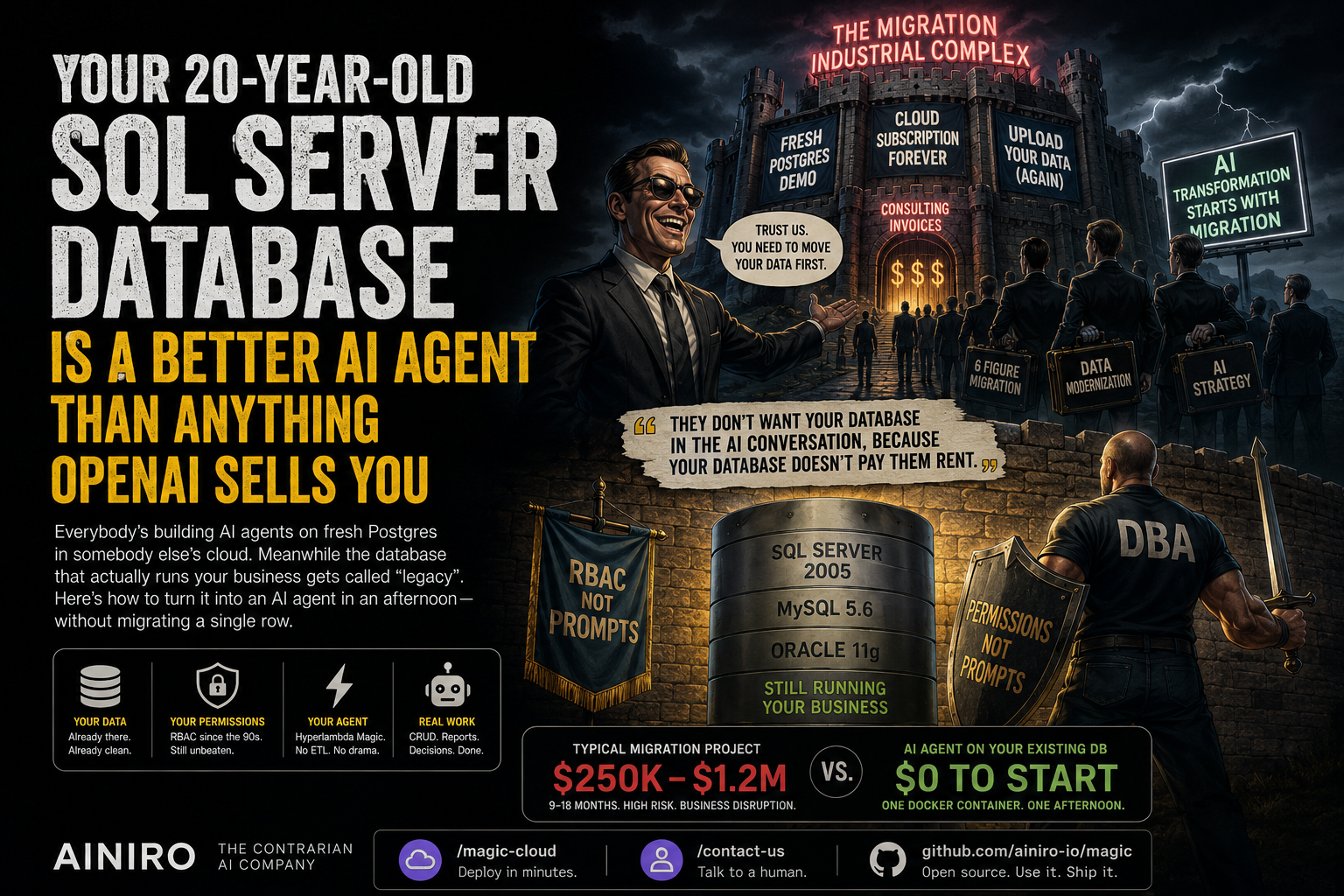
A typical migration project for a real production database runs anywhere from $250,000 to $1.2 million, takes 9 to 18 months, and carries genuine risk of breaking the business it was supposed to "transform". And here's the punchline: at the end of it, you still don't have an AI agent. You have the same data in a different database, and a fresh invoice.
Meanwhile, the actual thing you wanted - an AI agent that can answer questions about your customers, your orders, and your tickets - never required moving anything at all.
Prompts are not permissions
Now, the other camp will tell you migration is unnecessary because you can "just let the LLM write SQL against production". These people are even more dangerous than the consultants, because at least the consultants only steal your money.
Handing a language model a raw database connection and a system prompt saying "please only read, don't drop anything" is not security. It's a horoscope. Prompts are suggestions. The model can be confused, jailbroken, or simply wrong - and your production database will happily execute whatever it produces, because your production database was never asked for its opinion.
The correct answer is the one your database has been screaming at you since the 90s.
RBAC, not prompts. Permissions, not vibes.
With Magic Cloud, the architecture is boring on purpose. You create a scoped database user - ordinary DBA hygiene, enforced by SQL Server or MySQL itself. Magic connects as one more client, reads your schema, and generates secured CRUD endpoints for exactly the tables you select, each one wired with authentication and role-based access control. Its native MCP server then exposes those endpoints as tools to Claude, or any MCP-capable agent.
The agent never sees a connection string. It never writes SQL. It gets a toolbox, filtered by the roles it authenticated with, and an endpoint outside its roles doesn't refuse politely - it does not execute. Underneath even that sits the scoped database user, enforced by the one component in your stack you already trust completely.
Three layers of enforcement, zero layers of prompt engineering. If you want the full step-by-step - scoped user, connection, CRUD generation, MCP - I wrote a detailed practical guide over at hyperlambda.dev. The whole path is an afternoon, and your database remains completely unchanged throughout.
The Hyperlambda Generator, or why hallucinations bounce off
Generated CRUD covers 80% of what an agent needs. For the rest - the weird reporting join, the custom workflow, the endpoint nobody predicted - you use the Hyperlambda Generator. Describe the endpoint in plain English, and a fine-tuned LLM writes the Hyperlambda for you.
"But LLMs hallucinate!" Yes, they do. Which is exactly why we didn't build this the way everybody else builds it.
First, the model isn't guessing at some general-purpose language with a billion Stack Overflow answers of varying quality. Hyperlambda is a small, constrained runtime, and the generator was fine-tuned specifically for it. Smaller surface, radically fewer ways to be wrong.
Second - and this is the part the "agentic coding" crowd hasn't figured out yet - the platform is self-describing at runtime. Every capability the runtime has can be enumerated and queried as ground truth on the actual server the code will run on. The generator doesn't recall what the platform can do from training data that might be stale; the platform tells it. Hallucinated capabilities become structurally impossible to ship, because a capability that doesn't exist has nowhere to execute.
Third, generated code runs inside the whitelisting system. The runtime maintains an explicit list of what code in a given context is allowed to touch, enforced at the interpreter level. So even in the worst case - a confused generation, a hostile prompt, whatever - the code physically cannot reach beyond its whitelist. It can't hand the guest role your PII, because the interpreter refuses to execute the attempt.
Compare that to a coding agent free-styling Python against your production connection string, and tell me again which database is "legacy".
The numbers
Let's put the two paths side by side, for the identical outcome - an AI agent operating on your existing business data:
The migration path: $250K to $1.2M, 9 to 18 months, a rewritten integration landscape, retrained staff, and a risk profile that keeps your CTO awake. And the agent work hasn't even started yet.
The Magic path: $0 to start. Magic is open source - clone it, Docker it, run it forever, including fully on-premise behind the same firewall your auditors already approved. One container next to your database, one afternoon of work, and the data never leaves your network. No per-seat tax, no per-row upload pricing, no rent.
That's not a 10% optimization. That's an entire budget line evaporating, plus a year of calendar time you get back.
The honest version
I'm not going to pretend this makes every database problem disappear. If your schema is genuinely rotten, an AI agent on top of it will give you fast, well-secured answers derived from rotten data - garbage in, garbage out, now with better latency. And start read-only. A read-only agent over real business data is already massively useful, and it turns "what if the agent writes something wrong" into a non-question for day one. Grant writes table by table, when you're ready, as deliberate decisions - the same way your DBA has granted everything else for twenty years.
Which is really the whole point. The security model that protects your business from an over-eager AI agent isn't some new invention you need to learn. It's the one sitting in your database already, ignored by every vendor whose business model depends on you abandoning it.
Your "legacy" database isn't the thing holding your AI strategy back. It's the only part of your AI strategy that was finished before you started.
Get started with Magic Cloud, or talk to us if you'd rather we show you on your own stack.